What is Geothermal Energy
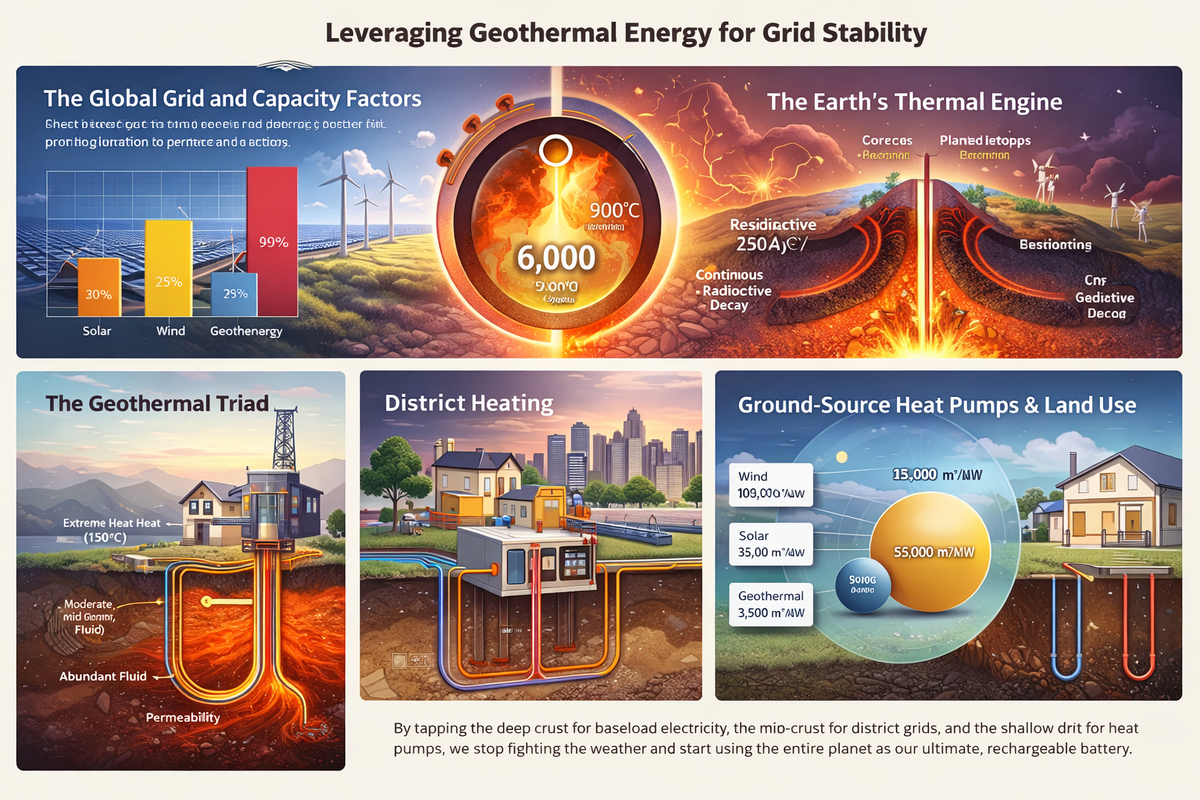
The Global Grid and Capacity Factors The global race to decarbonize the power grid is in full swing, and right now, we are leaning heavily on installations like these, massive wind and solar farms. But relying on the weather creates a physical limitation for the grid. The moment the wind dies down or the sun sets, the power drops. Engineers measure this reliability using something called capacity factor, which is simply the percentage of time a power source is actually generating electricity. This bar chart compares those capacity factors. It shows solar generating power about 20% of the time, and wind around 45%. But over on the right, geothermal energy operates at greater than 90% capacity. To prevent grid collapse as we phase out fossil fuels, we need a clean, weather-independent baseload power source. We need something that stays on, 24 hours a day, to cover the gaps.
The Earth's Thermal Engine The solution is literally beneath our feet. If you drill deep enough, the center of the planet burns at roughly 6,000 degrees Celsius, about as hot as the surface of the sun. Curious. This immense thermal energy has two origins. First, residual friction from the violent formation of the planet 4.6 billion years ago. Second, elements like uranium scattered throughout the crust undergo continuous radioactive decay, releasing new heat. Together, these processes create a continuous geological heat engine, a zero-emission energy reservoir. Current analysis by the International Energy Agency estimates the technical potential of these systems is enough to meet global electricity demand 140 times over.
The Geothermal Triad Tapping into this immense thermal energy for grid-scale electricity involves drilling miles deep into the crust to build conventional geothermal power plants. Generating electricity requires finding a natural hydrothermal system, which needs three overlapping ingredients. First, extreme heat, over 150 degrees Celsius. Second, abundant fluid to transport that heat. And third, high permeability, fractured rock allowing superheated fluid to circulate and flow up the well. Getting all three of those conditions to line up in one spot is incredibly rare. As a result, traditional geothermal power development has historically been locked to very specific geographic zones. Those zones are almost exclusively tectonically active areas and volcanic regions, severely limiting global deployment.
District Heating While deep geothermal provides perfect, constant electricity, the strict geological recipe means we cannot build these plants everywhere. But electricity is only half the story. We do not need 150-degree steam if our goal is simply to warm up a building. We can bypass the complex electricity conversion process entirely and use the earth's thermal energy directly. This is the principle behind district heating. Instead of drilling for extreme heat, cities drill to moderate, mid-depth temperatures to safely heat water. A centralized hub distributes hot water through a municipal underground network, replacing thousands of individual gas boilers. During summer, cities capture surplus waste heat, pump it backward into underground reservoirs, and save it for winter. Because these moderate temperatures are found nearly everywhere, municipal-scale geothermal becomes a viable option for cities across the globe, removing the historical requirement for a nearby volcano.
Ground-Source Heat Pumps & Land Use If we ascend even higher, just a few feet below the grass in your backyard, we find that the shallow dirt remains at a perfectly stable temperature year-round, entirely insulated from the weather above. Ground-source heat pumps exploit this exact stability. They use closed-loop pipes filled with liquid to extract warmth directly from the dirt and carry it indoors to heat a home during the winter. In the summer, the process reverses. The exact same system pulls excess heat out of the house and sinks it back into the cool earth. This bubble chart illustrates the land-use efficiency of these different power sources. Unlike the massive surface area required by wind and solar farms, geothermal boasts the smallest footprint of any energy source, coming in at just 3,500 square meters per megawatt. By tapping the deep crust for baseload electricity, the mid-crust for district grids, and the shallow dirt for heat pumps, we stop fighting the weather and start using the entire planet as our ultimate, rechargeable battery.
Comments ()