The European Energy Grid Crisis: A Systemic Analysis of the "Generation Paradox"
Executive Summary
IIIP: Grid Saturation Simulator
Adjust the parameters below to simulate the physical and financial impact of the 2026 renewable pipeline against the current infrastructure.
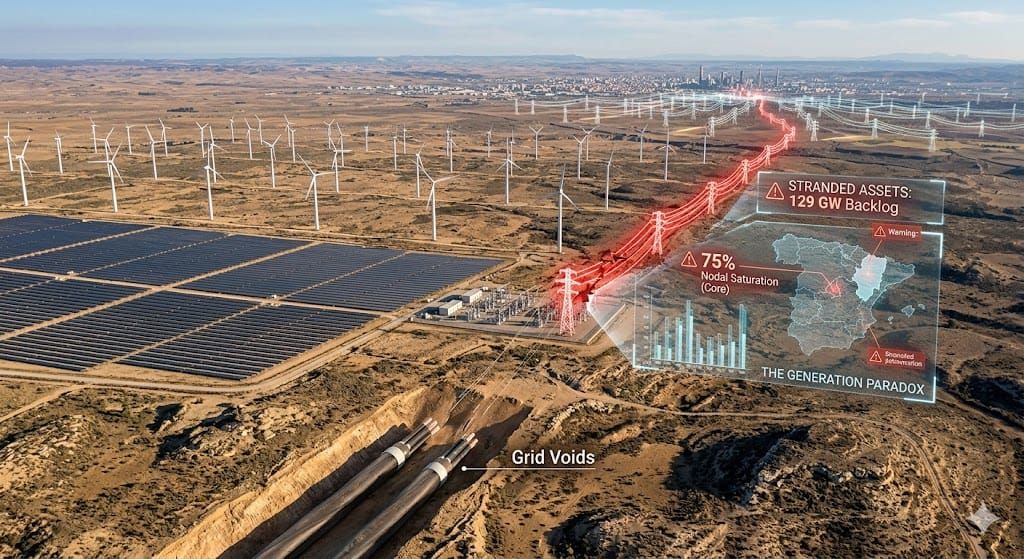
The European energy transition has reached a critical structural bottleneck characterized by a fundamental decoupling of renewable energy deployment from the physical infrastructure required to carry it. While renewable generation is being added at record speed (e.g., Spain’s 129 GW pipeline), the grid "backbone" remains stagnant, leading to what analysts call the Generation Paradox: generation is being built in "grid voids" where infrastructure is thin, while industrial and urban hubs remain starved for power due to grid saturation.
In 2024 alone, EU countries spent €4.3 billion on congestion management—roughly 60 TWh of electricity, equivalent to Austria's annual consumption. Projections suggest these costs could exceed €20 billion by 2030. Physical grid exhaustion manifested violently in the April 2025 Iberian Blackout, a cascading failure driven not by a lack of power, but by a lack of stabilizing inertia and voltage control in a system dominated by inverter-based renewables.
To avert systemic failure, Europe faces a €1.6 trillion investment challenge by 2040. Success requires a shift from "political spreadsheet" planning to "spatial logistics," incorporating nodal pricing, aggressive deployment of Grid-Enhancing Technologies (GETs), and the urgent modernization of distribution grids, which have emerged as the true hard constraint of the transition.
--------------------------------------------------------------------------------
1. The Spanish Grid Audit: Mapping Nodal Saturation
A forensic spatial audit of the Spanish peninsula’s infrastructure in early 2026 reveals a system operating at its absolute physical limits. The data disproves aggregate reports suggesting Spain has "plenty of power" by highlighting a severe geographical mismatch.
1.1 The Components of the "Generation Paradox"
- The Saturated Cores: High-density infrastructure zones (Madrid, the Mediterranean corridor, the Basque coast) are operating with 75% of transmission nodes at zero available capacity.
- The Generation Sprawl: Massive clusters of wind and solar assets in regions like Aragon, Galicia, and Castile and León are situated in "Grid Voids"—zones where high-voltage infrastructure is physically too thin to export the load.
- The "Clash" of Tech Titan Clusters: Over 20 hyperscale nodes (e.g., AWS, Equinix) are attempting to cluster precisely within the most saturated cores, creating a physical infrastructure conflict.
1.2 Capacity and Backlog Data (REE 2026 Audit)
The Red Eléctrica (REE) audit identifies a massive backlog of previously granted permits that the grid is physically unable to accommodate:
|
Spanish Grid Component |
Granted Capacity Backlog |
Top Regions for Theoretical Headroom |
|
Wind and Solar PV |
129 GW |
Severely Limited (Nodal Specific) |
|
Energy Storage (PEI) |
16 GW |
Castile and León (>18 GW), Aragon (~11 GW) |
|
Demand Facilities (PEI) |
19 GW |
Galicia (9.3 GW), Castile and León (7.8 GW) |
--------------------------------------------------------------------------------
2. The Iberian Blackout Case Study: A Warning for Europe
On April 28, 2025, the Iberian Peninsula suffered a catastrophic cascading grid collapse that resulted in eight fatalities and decoupled the high-voltage lines between France and Spain.
2.1 Causes of the Collapse
ENTSO-E investigations concluded the blackout was a first-of-its-kind failure driven by:
- Lack of Synchronous Inertia: As traditional thermal plants were retired, the system lost the mechanical "stabilizing buffer" they provided.
- Inverter Fragility: The grid was dominated by solar and wind inverters that were historically prohibited from providing dynamic voltage control.
- Cascading Instability: A failure at a substation in Granada triggered overvoltage protection disconnections across Badajoz and Sevilla within a five-second window.
2.2 The "Reinforced Mode" Paradox
Following the blackout, the Spanish TSO was forced into a "reinforced mode," mandating the continuous operation of fossil-fueled Combined Cycle Gas Turbines (CCGTs) solely for grid stabilization. This created a zero-sum conflict: the electrons from gas plants displaced renewables on congested lines, causing renewable curtailment to triple (from 1.8% to 7.2%). By May 2025, stabilization costs reached €24/MWh, accounting for 57% of the total final electricity price.
--------------------------------------------------------------------------------
3. The Distribution Grid: The Transition's True Hard Constraint
While transmission (the "motorways") faces challenges, the distribution grid (the "local roads") is the primary bottleneck for 21st-century electrification.
- Engineering Obsolescence: Existing distribution infrastructure was designed for one-way power flow from central plants to passive consumers. It cannot handle the bidirectional flow required by EVs, heat pumps, and distributed solar.
- Edge Failures: In Spain, 88% of distribution grid nodes were saturated with less than 1 MW of firm available capacity in 2024.
- The Investment Gap: Europe faces a €400 billion investment gap for distribution grids alone by 2040. Most new generation and storage assets are designed to connect at these low/medium voltage levels.
--------------------------------------------------------------------------------
4. Hardware Bottlenecks and the "Supercycle"
The transition is increasingly constrained by the physical supply of hardware rather than policy or capital availability.
- Transformer Shortages: Lead times for large transformers (100 MVA+) have more than doubled since 2019. In the US, prices have surged by 79%.
- Procurement Delays: High-end manufacturing systems for grid components now have lead times of two to four years.
- Resource Intensity: The transition depends on copper, grain-oriented electrical steel, and specialized inputs often concentrated in geopolitically exposed supply chains.
--------------------------------------------------------------------------------
5. Market Design and Regulatory Failures
The European market continues to trade power on a "frictionless copper plate" model that ignores the physical reality of thermal limits.
5.1 The 70% MACZT Rule
EU regulation mandates that 70% of transmission capacity be available for cross-zonal trade. However, in 2024, TSOs routinely restricted this to 30%–50% as a "self-defense mechanism" to prevent internal lines from melting due to international transit flows.
5.2 Locational Marginal Pricing (LMP) vs. Zonal Pricing
- The Problem: Current zonal prices are too coarse to reflect localized bottlenecks, forcing expensive ex-post "redispatching."
- The Solution: Transitioning to Nodal Pricing (LMP), where every node has a distinct price based on local constraints. This would provide real-time signals for siting batteries and electrolysers.
- Bidding Zone Splits: Simulations of splitting the Germany-Luxembourg zone into five distinct areas showed potential economic efficiency gains of up to €339 million annually.
--------------------------------------------------------------------------------
6. Emerging Risks: Green Hydrogen and Flexibility Gaps
6.1 Grid Cannibalization via Hydrogen
Uncoordinated siting of green hydrogen electrolysers could add 78 TWh of avoidable congestion by 2040. If electrolysers are sited near industrial users rather than renewable sources, they act as parasitic loads on saturated corridors. This leads to "grid cannibalization," where electrolysers are regulatory-certified as "green" but physically run on fossil-fired redispatch power because the renewable energy cannot reach them.
6.2 The Flexibility Penalty
Despite the need for Battery Energy Storage Systems (BESS) to prevent blackouts, outdated grid tariffs often "double-tax" these assets during both injection and withdrawal. In Spain, BESS assets acting as flexible demand lose approximately €20,653 per megawatt annually due to rigid regulatory frameworks.
--------------------------------------------------------------------------------
7. The Trillion-Euro Challenge: Investment and Policy Needs
To meet 2040 climate goals, the European Commission estimates a need for €1.6 trillion in grid investments.
|
Investment Category |
Required Funding to 2040 |
|
Electricity Transmission & Distribution |
€1.4 Trillion |
|
Hydrogen Networks |
€240 Billion |
|
Current Investment Gap (Distribution) |
€400 Billion |
|
Current Investment Gap (Transmission) |
€190 Billion |
7.1 Grid-Enhancing Technologies (GETs)
GETs (hardware/software upgrades like Dynamic Line Rating) could increase network capacity by 20% to 40% without the 10-year permitting delays of new lines. Despite this, they are not yet systematically included in national grid planning.
7.2 The 2026 European Grids Package
Expected in Q1 2026, this package aims to:
- Shift to top-down, centralized planning to replace the flawed bottom-up TYNDP process.
- Streamline permitting for Projects of Common Interest (PCIs).
- Increase the Connecting Europe Facility (CEF) budget (currently €5.84 billion, deemed insufficient).
--------------------------------------------------------------------------------
Conclusion: Build the Backbone First
The current strategy of "replacing the machine before building the backbone" is structurally unstable. Counting nameplate capacity for renewables or EVs is insufficient if the grid cannot absorb the load. Future resilience depends on aligning spatial data with capital deployment, reforming network tariffs to reward flexibility, and recognizing that the grid is no longer a political spreadsheet but a hard physical constraint on the survival of the energy transition.
Comments ()