The €8.9 Billion Grid Tax: Why the European Energy Transition is Bleeding Capital.
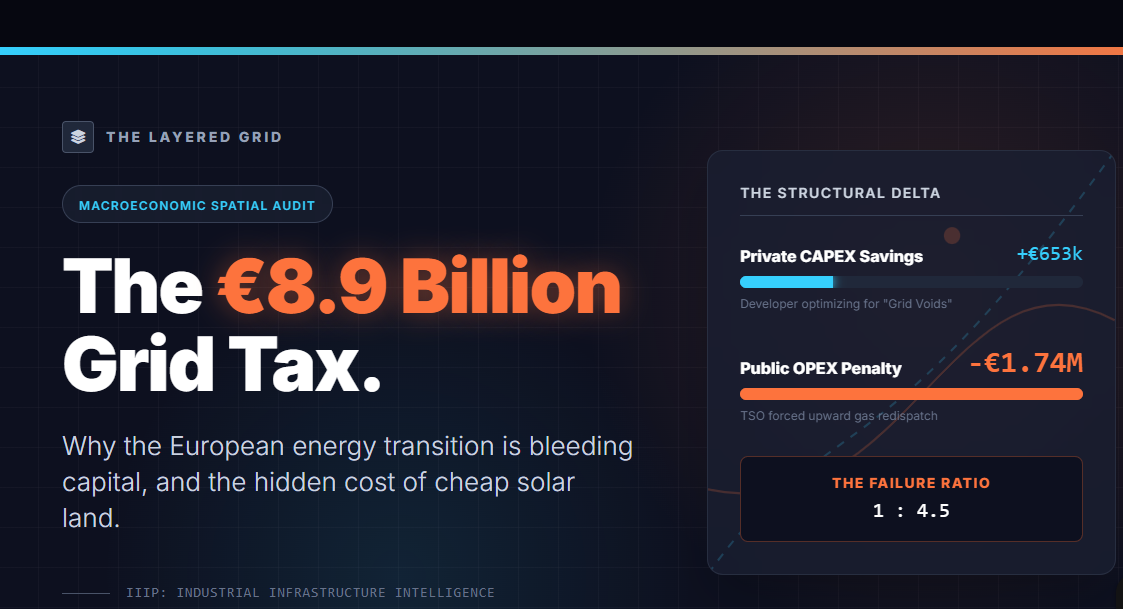
The €8.9 Billion Grid Tax
Why the European energy transition is bleeding capital, and how poor spatial planning is decoupling generation from the transmission backbone.
€8.9B
EU Congestion Cost (2024)
€2.66B
Spain System Adjustment Cost
Perverse
Incentive Structure
The Private Optimization: Land Arbitrage
For a standard 50 MW solar plant requiring 100 hectares, developers relentlessly chase the lowest Levelized Cost of Energy (LCOE) by targeting "Grid Voids."
Annualized Private CAPEX Savings (30yr @ 6% WACC)
+ €653,000 / yr
The Public Penalty: The "Grid Tax"
When power from the Grid Void hits a saturated transmission node, the TSO executes a deeply inefficient, two-step redispatch process.
1. Downward Redispatch
TSO curtails zero-carbon, zero-marginal-cost solar energy trapped in the void.
2. Upward Redispatch
TSO pays €165 - €295/MWh to turn on fossil-fired gas (CCGTs) near urban demand centers.
Annualized OPEX Penalty for 11% Curtailment
- €1,740,000 / yr
The 1 : 4.5 Failure Ratio
The math proves we are subsidizing a locational mismatch. The developer saves €653k on land; the system pays €1.74M in friction.
Private Developer Benefit
€653,000
Public Consumer Penalty
€1,740,000
The Regulatory Reckoning
Regulators across Europe are realizing they can no longer socialize the cost of poor site selection. The era of the "Grid Void" land grab is ending.
-
🇬🇧 UK (NESO)
Transitioning from "first-come, first-served" to "first-ready-and-needed" tied to a Strategic Spatial Energy Plan.
-
🇮🇹 Italy (TE.R.R.A.)
TSO rolling out a digital platform mapping grid development against connection requests to force zoning compliance.
-
🇪🇺 EU (RED III)
Mandating "Renewable Acceleration Areas" requiring grid capacity mapping *before* granting environmental exemptions.
IIIP
Industrial Infrastructure Intelligence
Eradicating this "Grid Tax" requires a fundamental shift. Mandatory pre-permit spatial constraint analysis is becoming a regulatory requirement.
By integrating macro-level electrical constraints with micro-territorial feasibility, IIIP stops the deployment of generation where the grid doesn't exist, routing capital to corridors that can actually handle the electrons.
"Capital deployment must follow spatial physics. Everything else is just expensive friction."
In 2024, the European Union spent an estimated €8.9 billion on congestion management, with billions more lost to the forced curtailment of renewable energy. In Spain alone, system adjustment costs surged to €2.66 billion.
We often discuss "curtailment" as an unavoidable engineering headache—a byproduct of variable weather. It is time to rebrand this phenomenon for what it actually is: a Structural Grid Tax levied against poor spatial planning.
Currently, the energy transition operates on a perverse incentive structure. Project developers relentlessly optimize their Levelized Cost of Energy (LCOE) by chasing the cheapest land acquisition and the highest meteorological yield. However, they treat transmission capacity as a secondary, externalized problem.
We are systematically decoupling the generation machine from the transmission backbone, and the math proves it.
The Private Optimization: The Land Arbitrage
To understand the crisis, you have to look at the civil works and land CAPEX. A utility-scale developer needs roughly 100 hectares for a standard 50 MW solar plant.
If they attempt to build near a major demand center with high nodal headroom (like Barcelona), agricultural land can demand €95,000 per hectare. But if they target a rural "Grid Void" (like Aragon or Extremadura), land drops to roughly €5,000 per hectare.
By choosing the remote grid void, the developer saves €9,000,000 in upfront CAPEX. Amortized over a 30-year lifespan at a 6% WACC, that is an annualized private saving of roughly €653,000.
From a purely private LCOE perspective, building in the grid void is a financial no-brainer. But it creates a catastrophic systemic failure.
The Public Penalty: The Mechanics of the "Grid Tax"
When you build a 100MW solar park in a "Grid Void" simply because the hectares were cheap, you have not solved a capacity problem. You have created a stranded asset.
When peak midday solar hits the saturated local transmission nodes in Aragon, the power physically cannot escape. The Transmission System Operator (REE) is forced to intervene via the technical restrictions market. This triggers a deeply inefficient two-step process:
- Downward Redispatch: The TSO forces the remote solar plant to curtail its zero-carbon, zero-marginal-cost energy.
- Upward Redispatch: To replace that lost power, the TSO must turn on expensive, fossil-fired Combined Cycle Gas Turbines (CCGTs) safely downstream of the bottleneck, near the urban demand centers.
The financial cost of this operation is staggering. While the curtailed solar might have cleared the market at €25/MWh, the TSO is forced to buy upward gas redispatch at €165/MWh to €295/MWh.
The 1:4.5 Failure Ratio
When we model this out for our 50 MW test case experiencing an 11% curtailment rate, the systemic cost of replacing that stranded solar with gas redispatch equals an OPEX penalty of €1.74 Million per year.
The developer saves €653,000 on land; the system pays €1.74 million in friction.
For every €1 the developer saves on rural dirt, the electricity consumer pays roughly €4.50 in "Grid Tax" to subsidize the locational mismatch. ### The Regulatory Reckoning We cannot continue to execute the energy transition via political spreadsheets and zonal pricing models that ignore physical AC grid topology. Capital deployment must follow spatial physics.
Fortunately, the era of the "Grid Void" land grab is ending. Regulators across Europe are realizing they can no longer socialize the cost of poor site selection:
- The UK (NESO): Transitioning away from "first-come, first-served" queues to a strict "first-ready-and-needed" model tied to a Strategic Spatial Energy Plan.
- Italy (TE.R.R.A.): The TSO is rolling out an integrated digital platform mapping grid development directly against connection requests to force regional zoning compliance.
- The EU (RED III): Mandating "Renewable Acceleration Areas" (RAAs) that explicitly require mapping grid capacity before granting environmental exemptions.
The IIIP Solution
Eradicating this "Grid Tax" requires a fundamental shift in how we permit and deploy capital. Mandatory pre-permit spatial constraint analysis is no longer a luxury; it is becoming a regulatory requirement.
This is the exact ideological foundation behind IIIP: Industrial Infrastructure Intelligence. By integrating macro-level electrical constraints with micro-territorial feasibility, we can stop building generation where the grid doesn't exist.
If we don't map the physical reality of nodal headroom, transmission saturation, and local distribution bottlenecks before a single euro of capital is committed, everything else is just expensive friction.
Comments ()