The €2 Billion Paradigm Shift: Why Institutional Capital is Finally Funding the Copper
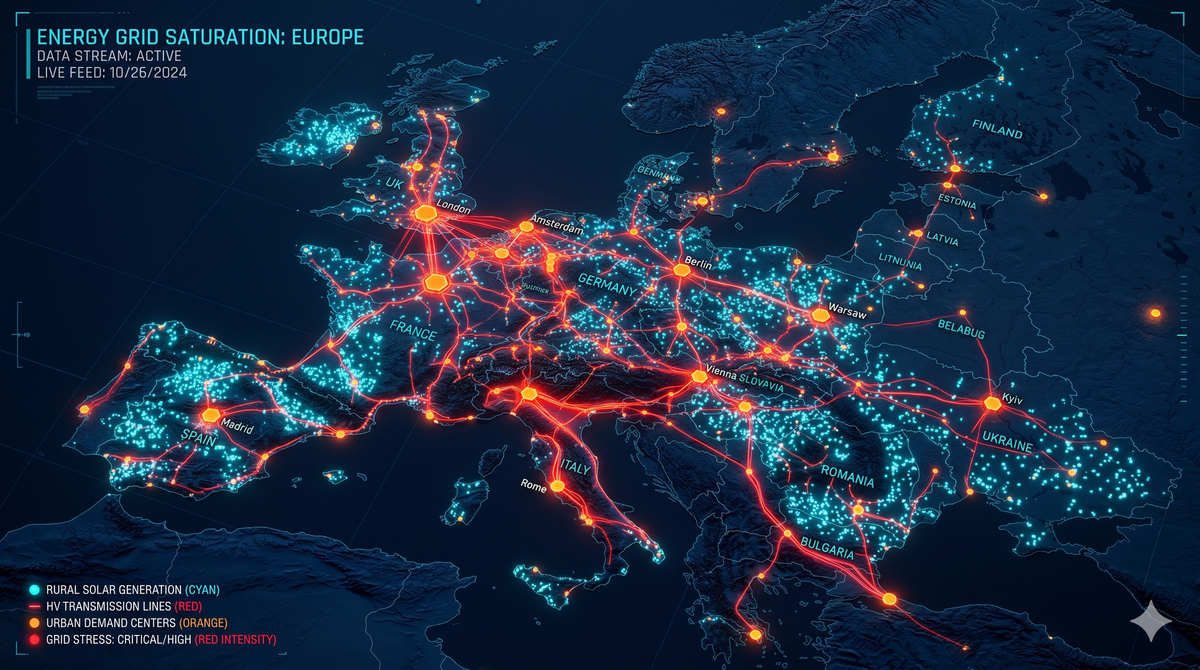
The European Union just put €2 billion behind transformers, not turbines. Here is why that matters more than any new wind farm announcement.
For ten years, the energy transition focused almost exclusively on generation capacity. Governments and investors celebrated gigawatt-scale solar arrays and massive offshore wind. They ignored a basic law of electrical engineering. Generation without a grid is just a stranded asset on a spreadsheet.
European policymakers finally realize the transition depends entirely on the physical infrastructure that moves electrons. The high-voltage cables, switchgear, and transformers form the actual foundation. The entire project stalls right here.
On April 20, 2026, the European Investment Bank (EIB) and Commerzbank signed a €250 million portfolio guarantee. This agreement unlocks up to €2 billion in direct grid investments across the EU. It is the first transaction under the pan-European EIB Grid Package. Future operations will mobilize up to €4 billion each. Brussels is finally backing physical grid hardware instead of subsidizing generation targets.
Our work at IIIP: Industrial Infrastructure Intelligence proves the hardware gap is the terminal constraint. We audit line congestion, thermal limits, and transformer shortfalls. The theoretical capacity of a wind farm means nothing if the downstream infrastructure cannot physically take the load. The EIB transaction responds directly to these exact constraints.
The Macroeconomic Imbalance: Generation Capacity vs. Transmission Reality
Clean energy investment in the EU reached $390 billion by 2025. Wind and solar accounted for 30% of total EU electricity generation that year, beating all combined fossil fuels.
This generation boom exposed a massive lack of grid investment. The investment ratio of renewable generation to fossil fuels hit 35:1. Grid spending doubled to $70 billion but still lags far behind. Across global advanced economies, 1,650 GW of solar and wind projects are stuck in interconnection queues. They have financing and land. They just lack the physical grid capacity to export power.
Auditing Physical Grid Constraints: The Hardware Gap
When IIIP audits a high-voltage transmission corridor, we do not just look at financial models. We evaluate the thermal capacity of overhead lines, substation step-up capacity, and transformer endurance.
The grid must perfectly balance supply and demand every millisecond. Existing infrastructure was built forty years ago for centralized fossil fuel plants. It lacks the copper and switchgear to route volatile renewable power flows. The hardware gap is a literal lack of aluminum and electrical steel positioned in the correct geographic locations.
The Physics and Economics of Gridlock
Failing to upgrade the physical grid causes severe economic damage. The clearest symptom is redispatching.
When wind blows strongly in northern Germany, the generation exceeds the capacity of the high-voltage lines running south. The Transmission System Operator must intervene to prevent overloaded cables. The operator curtails the northern wind farms and pays carbon-intensive gas plants in the south to spin up.
In 2023, grid bottlenecks in Germany required the balancing of 27,000 GWh of electricity. The direct cost for this inefficiency hit €3.2 billion for that single year. The EIB's €250 million guarantee to unlock permanent grid hardware is a simple efficiency play compared to that deadweight loss.
The Financial Engineering of the EIB Guarantee
This is not a direct utility loan. It is a risk-sharing mechanism to bypass commercial banking limits.
Buyers pay Original Equipment Manufacturers (OEMs) advance cash to secure long-term manufacturing slots. The OEM's commercial bank issues performance guarantees in return. The European grid component market is highly consolidated. Banks quickly hit Basel regulatory limits for risk exposure to these few massive OEMs.
The EIB Grid Package steps in right here. The EIB provides Commerzbank with a €250 million guarantee covering up to 50% of the risk. Transferring default risk to a AAA-rated institution gives Commerzbank regulatory capital relief. They can now issue more guarantees to OEMs.
The Hardware Supercycle and Factory Expansions
This financial mechanism fights severe physical limits. The sudden global push for grid modernization broke the supply chain for electrical equipment.
OEMs operate at maximum capacity. Siemens Energy reported a grid segment order backlog of €45 billion by the end of 2025. Hitachi Energy saw its backlog surge to $56.7 billion. These numbers represent multi-year waiting lists for hardware. Lead times for Large Power Transformers stretch from 48 to 60 months.
The EIB Grid Package directly funds factory expansions to clear these backlogs. Siemens Energy is deploying €220 million to expand its Nuremberg transformer factory. The company also spent €100 million on a wind power transformer plant in Austria. Hitachi Energy is building a new facility in Ludvika, Sweden to increase transformer capacity by 40 percent. They are also expanding factories in Bad Honnef, Germany and Zaragoza, Spain.
The Sovereign Data Center: Hyperscalers Monopolizing Hardware
Hyperscale data centers make the hardware shortage worse. Technology giants block-purchase equipment directly from OEMs and bypass public utilities entirely.
Microsoft and OpenAI's 1.2 GW "Project Stargate" in Texas skipped the state interconnection queue completely. The developers bought aeroderivative gas turbines for 1 GW of bridge power and purchased massive 500 kV transformers directly from Taiwan's Fortune Electric.
Amazon Web Services awarded a $114 million contract to South Korea's LS Electric for specialized switchgear to avoid European factory congestion. Schneider Electric secured two US data center agreements in late 2025 totaling $2.3 billion. Highly capitalized tech firms now compete directly with regulated utilities for priority access to the same factories.
The End of the Transition Illusion
The shift to an electrified economy is entering its hardest phase. Wind and solar are the bedrock of European electricity generation. The new challenge is the physical logistics of moving that electricity.
The €250 million EIB guarantee clears the biggest obstruction in the European energy transition. Generation capacity without transmission infrastructure is an expensive illusion. The battle for energy security and economic competitiveness lies in the copper, steel, and silicon of the electricity grid.
Capital deployment must follow spatial physics.
The Great Grid Bypass
Analysis of hyperscaler procurement strategies (2025-2026). Big Tech is bypassing traditional utility queues by purchasing high-voltage hardware directly from European OEMs.
Timeline Compression
The standard utility connection queue is the single largest threat to AI deployment. By direct-purchasing transformers, Microsoft and AWS have reduced the time-to-power by nearly 60%.
The Procurement Pivot
Tech giants are no longer just "customers" of the grid; they are behaving like independent transmission operators. This chart maps the shift from passive to active hardware acquisition.
The Legacy Queue Model
The Strategic Direct-Buy Model
Direct Capacity (GW)
Data centers are locking up transformer production lines through 2027. Microsoft accounts for roughly 40% of all direct-buy orders in the EU.
Supply Dominance
European manufacturers are the primary beneficiaries. Siemens Energy remains the preferred partner for ultra-high voltage (UHV) gear.
Comments ()