The EU Grids Package Is Fracturing Before It Passes — and the 1,700 GW Queue Is Already the Cost
The EU Grids Package is Fracturing
Sweden threatens to freeze cross-border power connections over congestion revenue disputes, endangering the EU's primary tool for accelerating energy infrastructure.
1. The Political Deadlock
The EU Grids Package (COM/2025/1005), tabled in December 2025, was designed to be the ultimate catalyst for European energy integration. However, it is facing severe political friction before even clearing Parliament. Sweden's Energy Minister, Ebba Busch, has voiced strong objections to the provisions regarding congestion revenues. Member states are demanding flexibility in how these revenues are utilized, creating a standoff that threatens the very core of the European internal energy market.
The Swedish Ultimatum
"Unless member states retain flexibility in using congestion revenues, Sweden will freeze new power connections with EU neighbours."
The Development Bottleneck
Clean energy projects currently stuck in connection queues across Europe.
European Grid Connection Status
This visualization highlights the disproportionate scale of the problem. The capacity of projects waiting in limbo far exceeds the recent annual interconnection deployment rates, illustrating why the proposed 2028 market implementation is dangerously late.
2. The Timeline Paradox
The urgency of the gridlock is starkly contrasted by the lethargic legislative timeline. Declared a "priority file for 2026" under the Joint Declaration, the package is suffering from a massive paradox: the solution to today's crisis is more than two years away, and it is actively being watered down during negotiations.
Legislative Pathway to Implementation
Package Tabled
COM/2025/1005 introduced
Priority Negotiations
Political friction hits core mechanisms
Legislative Conclusion
Expected finalization of text
Full Implementation
Projects remain in limbo until this date
3. The Risk to Interconnectivity
Sweden's threat to halt new power connections directly undermines the EU's goal of a fully synchronized, resilient internal energy market. Congestion revenues, collected when power flows between regions with different prices, are fiercely contested. While the EU seeks centralized coordination and investment mandates, member states demand sovereign flexibility over these funds.
Impact Profile: Planned vs. At-Risk Capacity
This chart breaks down the conceptual impact of bilateral freezes on the broader European network. By withholding new cross-border connections, substantial projected capacities required for grid stability are placed in immediate jeopardy.
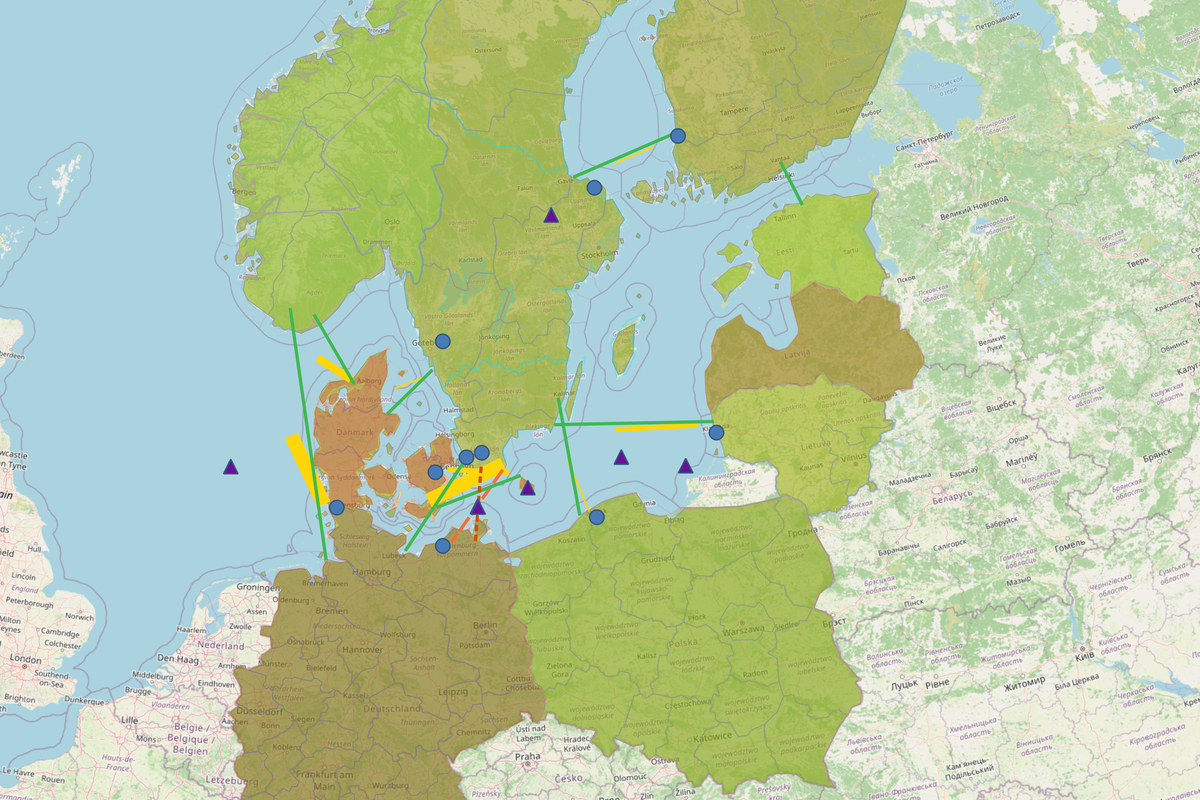
See the Interactive map here: https://maps.thelayeredgrid.com/EU_Grids_Package_Sweden_Veto.html
The European Commission's Grids Package was meant to be the legislative answer to the most expensive infrastructure failure in Europe's energy transition: 1,700 GW of renewable and hybrid projects stranded in connection queues across 16 countries. It is a priority file under the 2026 Joint Declaration. It has institutional backing from the Parliament, the Council, and the Commission. And it is already coming apart — over a financial mechanism most of the commentary has barely mentioned.
The fracture line is congestion revenue.
What the package actually proposes — and why Sweden objects
When power flows across a constrained interconnector, the price differential between the two bidding zones generates revenue. That revenue — collected by the relevant Transmission System Operators — is the financial fingerprint of a bottleneck. The Grids Package (COM/2025/1005, tabled December 2025) proposes to redirect a portion of those revenues into a coordinated EU-level infrastructure financing mechanism. The logic is straightforward: use the proceeds of the problem to fund the solution.
Sweden's energy minister Ebba Busch has rejected this logic flatly. Her objection is not procedural. It is structural: Sweden operates a functioning, transparent internal electricity market. Its TSOs generate congestion revenue because its grid is integrated and its pricing zones reflect real physical constraints. Asking Sweden to surrender that revenue to co-finance infrastructure deficits accumulated elsewhere — in markets that have consistently underinvested in their own transmission capacity — is, from Stockholm's perspective, a transfer of domestic wealth to underwrite other governments' failures.
The retaliation is proportionate to the provocation. Sweden has formally threatened to freeze new cross-border power connections to EU neighbours. That is not a negotiating posture. It is a veto capability, deployed.
The timeline paradox — and why 2028 is not a solution
The Grids Package is not expected to achieve legislative conclusion until late 2026 or early 2027. Standard transposition periods then push full internal market implementation to 2028. This is the timeline against which the urgency of the problem must be measured.
Those 1,700 GW of stranded projects are not waiting. The UK alone has 722 GW in queue. Finland has 400 GW. Italy is in a state the Commission's own assessments describe as virtual saturation — developers cannot identify viable connection points, not because of a permitting backlog, but because the grid nodes are exhausted. Germany has 70 GW queued against a north-to-south transmission deficit that its single-bidding-zone market design actively obscures from price signals.
The more precise framing: Europe is curtailing approximately €7.2 billion worth of renewable electricity annually across seven countries — paying generators to not produce power, socialising that cost through network tariffs, and raising industrial electricity prices to roughly twice US and Chinese equivalents. This is not a long-run structural trend. It is a recurring, measured operational failure happening now.
A 2028 implementation date for the legislation designed to fix this is not a paradox in the rhetorical sense. It is a quantifiable gap: every year of delay at current curtailment rates represents billions in stranded value, eroded competitiveness, and deferred decarbonisation. The urgency is immediate. The solution is conditional and distant.
The governance gap the package doesn't address
The congestion revenue dispute is a symptom of a deeper design failure that the Grids Package does not fully resolve: the absence of credible TSO accountability.
A comprehensive audit of 32 electricity TSOs across 28 countries reveals that the majority are planning on the basis of energy scenarios that systematically underestimate renewable growth trajectories. Only five TSOs are modelling for a power system in which coal and gas are fully replaced by renewables by 2035 — despite 13 European nations having binding political targets for exactly that outcome by that date. Eleven TSOs still operate under minimum unbundling arrangements, meaning they remain structurally connected to entities with commercial interests in the generation or retail markets they are supposed to neutrally facilitate.
Put directly: a significant portion of Europe's transmission planning is being done by institutions that have neither the mandate nor the incentive to plan for the system the legislation is designed to build. The Grids Package accelerates permitting and adjusts cost allocation. It does not structurally reform the bodies responsible for anticipatory investment.
Sweden's veto, in this framing, is not the problem. It is the diagnostic. The problem is a mechanism that asks efficiently managed systems to financially absorb the consequences of governance failures they did not cause and cannot correct.
What the fracture means for infrastructure capital
The investment requirement is not in dispute. The Commission estimates €1.2 trillion by 2040 — €430 billion for high-voltage transmission, €730 billion for distribution infrastructure that most analyses systematically underweight. The question is under what legislative conditions that capital deploys, and whether the Grids Package as currently structured provides those conditions.
If the Sweden objection is accommodated by softening the congestion revenue provisions, the financing mechanism loses coherence. If it is rejected, Sweden retains the credibility to follow through on its interconnection threat — which would fracture exactly the Baltic integration logic that the Harmony Link corridor (Baltic desynchronisation from BRELL) depends upon. The Bornholm Energy Island corridor, intended to pool Danish, Swedish, and German offshore wind through a shared hub, faces the same structural dependency.
Neither outcome is neutral for project timelines. Both outcomes are being processed by infrastructure investors while the queue sits at 1,700 GW.
The open question
The Grids Package was designed to align incentives across a fragmented system. Its congestion revenue mechanism instead exposed a deeper misalignment: between Member States that have invested in market integration and those that have deferred it, between TSOs that plan for the energy transition and those that plan around it, and between the urgency of the physical problem and the pace of the political solution.
Whether that misalignment resolves through negotiation or through dilution will determine whether 2028 marks the beginning of a functioning European internal energy market — or the date by which most of the queue has already made other arrangements.
See the Interactive map here: https://maps.thelayeredgrid.com/EU_Grids_Package_Sweden_Veto.html
Sources: Clean Energy Wire (May 2026) | Euronews (March 2026) | European Parliament Think Tank (February 2026) | Beyond Fossil Fuels / Ember / IEEFA connection queue survey | ENTSO-E TSO governance audit
Comments ()