The Blue Lagoon Was an Industrial Discharge Event.
The Blue Lagoon Was an Industrial Discharge Event.
What That Tells Us About the Real Complexity of Geothermal Energy
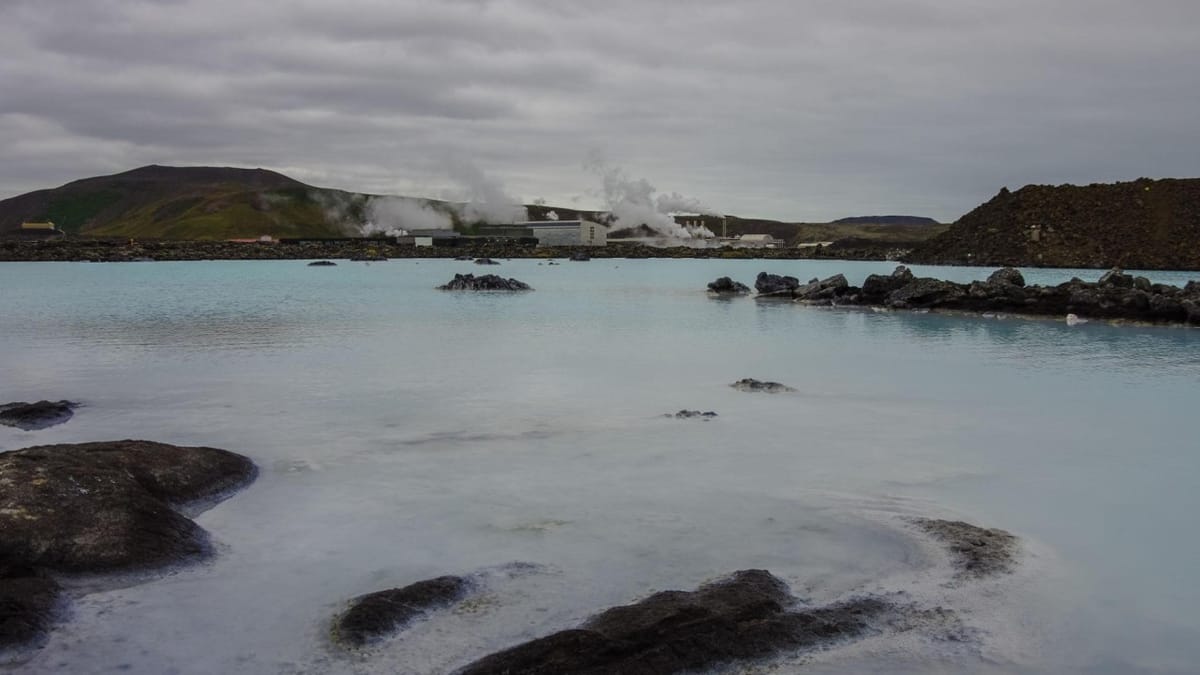
Most people who visit the Blue Lagoon in Iceland see a pristine geothermal spa. A reservoir engineer sees an industrial discharge event.
The lagoon exists because geothermal reservoir chemistry did not behave as engineers expected. At the HS Orka Svartsengi plant, the original engineering plan was straightforward: extract high-temperature geothermal brine (roughly 240°C at depth), separate the steam to generate electricity, and discharge the remaining silica-rich effluent into the surrounding basaltic lava fields. The assumption was that the fluid would simply infiltrate the porous rock and return underground.
The subsurface had other plans. As the brine cooled at the surface, the dissolved silica precipitated rapidly, permanently sealing the rock pores. The fluid could not infiltrate; instead, it accumulated. What began as a discharge management issue gradually became one of Iceland’s most visited sites.
But technically, it was a masterclass in scaling and reinjection. It proves that a geothermal reservoir is not a passive tank of hot water. It is a highly volatile, coupled thermo-chemical system. If you misjudge the subsurface chemistry, the reservoir will aggressively redraw its own plumbing.
🇮🇸 Iceland: When Nature Subsidizes the CAPEX
According to Statistics Iceland and the National Energy Authority, the country runs a grid where nearly 100% of electricity production is renewable—split roughly between 65–70% hydropower and 30–35% geothermal. Furthermore, 90% of residential heating is supplied directly by geothermal networks.
This is high-enthalpy volcanic geothermal. Sitting directly on the Mid-Atlantic Rift, Iceland has access to naturally permeable, extremely hot reservoirs at shallow depths.
- Drilling depth: 1.5–3 km
- Reservoir temperature: 200–300°C
- Capacity factor: 85–95%
- Plant size examples: Landsvirkjun Hellisheiði (~303 MW electric + ~133 MW thermal); Svartsengi (~75 MW electric + district heating)
These are steam-dominated or flash steam plants. Because nature provided the heat, the fluid, and the fracture networks, they operate as highly stable baseload units with unparalleled economics.
🇩🇪 Germany: The Engineering of Sedimentary Basins
Now compare that to Germany. Germany does not sit on a volcanic rift. To access geothermal energy, it must develop hydrothermal sedimentary systems. Nature does not provide the same subsidies here; the geology imposes a different tax.
In the Munich region (Molasse Basin), projects operated by municipal utilities like Stadtwerke München face a much heavier industrial lift:
- Drilling depth: 3–5 km
- Reservoir temperature: 120–160°C
- Output: Primarily district heating; electric generation is limited or secondary.
- Plant size examples: 20–40 MW thermal is typical. Electrical output is often under 5 MW, or entirely absent.
The disparity is stark. Germany’s total installed geothermal electric capacity remains under 50 MW nationwide, compared to Iceland's 750+ MW.
But judging Germany's geothermal sector by its electrical output is a strategic error. The prize in continental Europe is not the electron; it is the molecule. Germany’s geothermal thermal capacity is expanding rapidly, permanently stripping structural heating load out of the winter energy peak.
Northern Germany — Untapped or Underdeveloped?
Northern Germany (Lower Saxony, the Hamburg region, Schleswig-Holstein) sits on deep sedimentary basins with moderate geothermal gradients. The expected parameters here—3 to 4 km drilling depths yielding 100–150°C reservoir temperatures—offer limited high-efficiency electricity generation.
But they offer immense potential for district heating.
From a systems perspective, the contrast looks like this:
| Parameter | Iceland | Germany |
| Geological type | Volcanic rift | Sedimentary basin |
| Depth | 1.5 - 3 km | 3 - 5 km |
| Temperature | 200–300°C | 100–160°C |
| Electric MW | ~750–800 MW | < 50 MW |
| Capacity factor | 85–95% (electric) | 70–90% (thermal) |
The key difference is enthalpy. But both systems offer one crucial, overriding feature: Baseload stability.
The Shared Engineering Constraints
Whether volcanic or sedimentary, these are not "plug-and-play" assets. Sustaining that baseload stability requires managing a hostile underground environment. Both systems face severe constraints:
- Silica and Carbonate Scaling: Not just a maintenance issue, but a flow-path killer that can choke the wellbore.
- Parasitic Pump Load: The exponential increase in surface pumping power required to fight declining natural reservoir pressure.
- Reinjection Management: The risk of thermal breakthrough, where cold injected fluid short-circuits back to the production well.
- Induced Seismicity: A critical stress-management problem, particularly in densely populated sedimentary basins.
Germany’s higher drilling depths compound these issues. A 4-kilometer well exponentially increases the CAPEX, the exploration risk, and the mechanical complexity of the casing and cementing program.
But once operational, a geothermal district heating system physically displaces imported gas for decades. For a continent actively re-engineering its energy supply chains, that matters.
The Strategic Infrastructure Perspective
Wind and solar scale fast. Geothermal scales slow.
But when utility executives evaluate geothermal, they must stop looking at it as a power plant and start looking at it as infrastructure. Geothermal runs 24/7. It integrates directly into existing municipal heat networks. It requires no fuel imports. It provides physical inertia to stabilize fragile grids.
In engineering terms, it is a structural asset, not a variable input.
Iceland proves what is possible with geological advantage. Germany shows what is possible with engineering persistence.
The Strategic Question for Northern Europe
If electrification and heating decarbonization accelerate, Northern Germany faces a structural choice: Does it lean entirely on wind power and the promise of seasonal hydrogen storage? Or does it quietly build deep geothermal capacity to permanently stabilize its municipal heating networks?
Because while Iceland’s geology is exceptional, the engineering principles are transferable.
The Blue Lagoon was a byproduct of geothermal chemistry. The real story is long-term reservoir discipline and infrastructure patience. And that is where geothermal becomes strategically relevant for the continent.
If you are working in deep drilling, district heating infrastructure, or the Northern German energy transition, the conversation needs to shift from how fast we can build capacity to how we build stability.
Intermittent generation is growth. Baseload is resilience.
Comments ()