Geomechanical Discontinuity and Thermal Shock Dynamics in the North German and Molasse Basins:
A Critical Reassessment of Wellbore Stability in Deep Geothermal Exploration
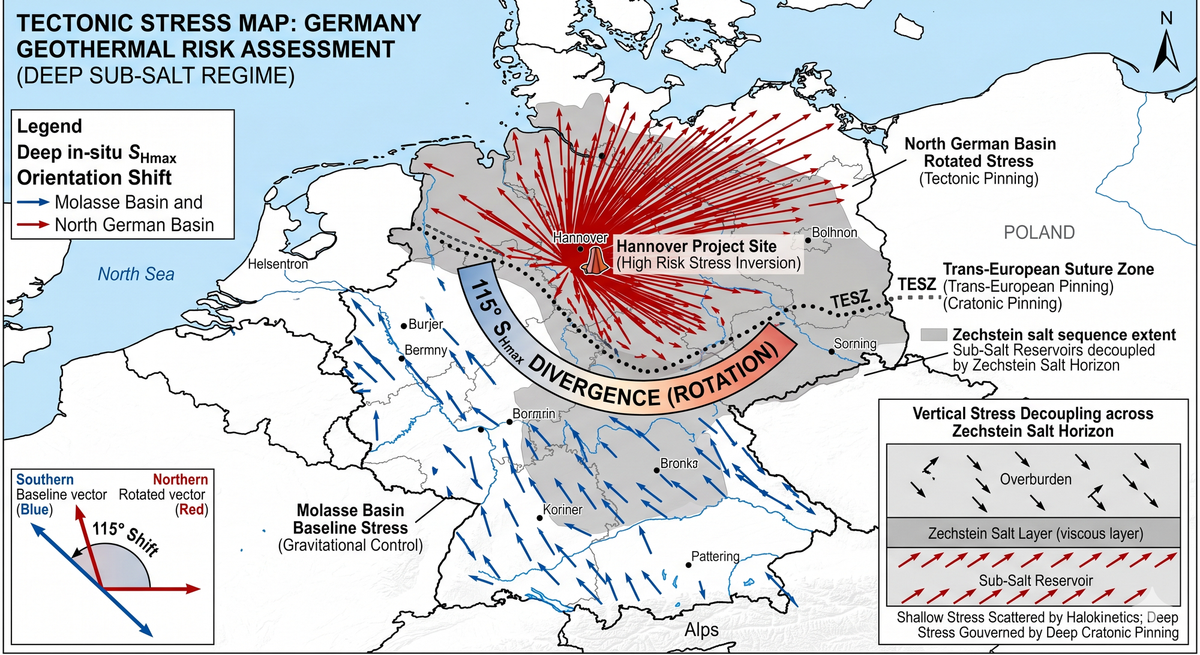
The expansion of geothermal energy across the European continent is currently facing a fundamental geomechanical crisis rooted in the over-reliance on analog-based transposition. As operators attempt to scale hydrothermal and petrothermal successes from the South German Molasse Basin to the North German Basin, a massive geomechanical blind spot has emerged. This blind spot is characterized by a 115° divergence in the orientation of the Maximum Horizontal Stress ($S_{Hmax}$), a deviation that fundamentally invalidates the operational parameters established in Southern Germany. This article examines the tectonic, stratigraphic, and thermo-elastic drivers of this discontinuity and outlines the terminal economic risks associated with "copy-paste" exploration strategies.
1. The Crisis of Analog Transposition
The assumption that geothermal development is a "copy-paste" operation is not merely a technical oversight; it is a financial and structural hazard. The geomechanical architecture of the North German Basin (NGB) defies the standard models derived from the Alpine Foreland. While the Molasse Basin (MB) exhibits a relatively predictable stress field controlled by the gravitational potential energy of the Alps, the NGB is subject to a complex interplay of far-field plate tectonic forces, regional pinning against the Trans-European Suture Zone (TESZ), and local mechanical decoupling facilitated by Zechstein salt sequences.
Consequently, transposing wellbore stability models without in-situ physical validation leads directly to multi-million-euro casing shear events. The reality of deep geothermal development is that acoustic sonic logs provide only inferences of rock properties, failing to offer the physical ground truth required to manage the dynamic thermo-elastic stresses of active quenching.
2. The Tectonic Divergence of Central European Stress Fields
The regional stress field of Western Europe is traditionally characterized by a dominant NW-SE orientation of S_Hmax, driven primarily by the ridge-push forces of the North Atlantic and the collision of the African and Eurasian plates. However, the NGB represents a significant and anomalous departure. In this region, S_Hmax orientations form a broad, fan-shaped pattern that rotates from NW-SE in the west to N-S and even NE-SW near the Polish border.
This rotation is the result of a mechanical interaction between three primary stress sources: the Atlantic ridge push, the Alpine collision, and the post-glacial rebound of Fennoscandia. Crucially, the Trans-European Suture Zone acts as a "pinning" point where the soft Phanerozoic lithosphere of Western Europe meets the rigid Precambrian Eastern European Craton. This forces the regional stress trajectories to bend, creating the 115° divergence when compared to the Molasse Basin.
| Region | SHmax Orientation | Primary Tectonic Driver | Geomechanical Characteristic |
| SW Molasse Basin (Swiss) | NW-SE (approx. 140°) | Alpine Topographic Gradient | Gravitational Potential dominated |
| NE Molasse Basin (Bavarian) | N-S to NNW-SSE | Alpine Front Collision | Consistent through basement |
| Western North German Basin | NW-SE | North Atlantic Ridge Push | Consistent with WSM trend |
| Eastern North German Basin | NNE-SSW to NE-SW | TESZ Pinning Effect | High Heterogeneity/Fanning |
3. Mechanical Decoupling and the Zechstein Shield
In the Molasse Basin, the stress field in the Mesozoic sediments is largely coupled with the underlying crystalline basement. Investigations in northern Switzerland found mean S_Hmax orientations in sediments ($166 \pm 12°$) to be nearly identical to those in the basement ($159 \pm 22°$).
The North German Basin presents a fundamentally different environment. The presence of the Zechstein salt sequence acts as a massive mechanical decoupling horizon that insulates sub-salt reservoirs (such as the Rotliegend sandstones) from the stress regimes acting on the overburden. Salt exhibits halokinetic behavior, creating a "thin-skinned" tectonic environment.
Research from the eastern NGB has documented vertical stress rotations of up to 90° across the Zechstein boundary. At depths below 5 km, the stress field tends to follow the regional N-S tectonic trend, but at shallower depths, the S_Hmax orientation can scatter wildly. For a geothermal operator, "historical data" from shallow wells is a liability; if a well is designed for a N-S stress orientation but the actual S_Hmax at reservoir depth has rotated 90°, the wellbore is immediately at risk of shear failure.
4. The Young’s Modulus Paradox and Acoustic Limitations
A common industry failure is the use of acoustic sonic logs to estimate the stress field. These logs measure P-wave (V_p) and S-wave (V_s) velocities to calculate dynamic elastic moduli. However, acoustic measurements do not represent physical ground truth. Numerical modeling has shown that while density and Poisson’s ratio variations have a negligible effect on stress rotation (typically <17°), a contrast in Young’s Modulus (stiffness) can cause significant stress rotations of up to 78°.
| Elastic Property | Effect on Stress Rotation | Maximum Observed Rotation |
| Young's Modulus ($E$) | High Sensitivity | Up to 78° |
| Poisson's Ratio ($\nu$) | Low Sensitivity | $\leq 17°$ |
| Density ($\rho$) | Low Sensitivity | $\leq 17°$ |
| Fault Friction | High (Local Only) | $\approx 19°$ |
Acoustic logs are particularly flawed during geothermal quenching. Acoustic velocities are highly sensitive to micro-cracks and pore fluids. As rock undergoes thermal shock, the P-wave velocity decreases as a function of stone degradation, making it a lagging indicator of failure rather than a predictive tool for stability.
5. Dynamic Thermo-Elasticity and the Thermal Shock Phase
Geothermal extraction is an exercise in managed thermal shock. "Active quenching"—injecting cold fluid into a 100–180°C reservoir—induces rapid contraction. This contraction generates thermo-elastic stresses not captured by isothermal models. The total stress state around the wellbore during injection is a superposition of tectonic, pore, and thermal contraction stresses:
sigma_{total} = sigma_tectonic - P_pore + fracE \alpha \Delta T 1 - \nu
Where:
- E = Young’s Modulus
- alpha = Coefficient of linear thermal expansion
- nu = Poisson’s ratio
- \Delta T = Temperature differential between reservoir and fluid
Because the tectonic stress tensor (sigma_tectonic) in the NGB is rotated 115° relative to Molasse baselines, the direction of minimum total stress shifts radically during quenching. Failure to account for this leads to mineral thermal expansion mismatch, tearing the rock apart at the grain boundaries and causing uncontrolled fluid loss or wellbore collapse.
6. Casing Shear: The Terminal Failure
Casing shear is the most severe manifestation of wellbore instability. In the high-temperature environments of the NGB, wells are subjected to thermal cycles that impose massive loads on the casing strings.
- Fault Slip: High pore pressure and thermal contraction reactivate faults. Misidentified stress orientation leads to wellbore trajectories that maximize shear load.
- Debonding: Thermal contraction causes the casing to pull away from the cement sheath, while simultaneously creating axial shear stress that exceeds the cement’s bond strength.
- Cyclic Fatigue: Repeated heating and cooling lead to steel fatigue, making the system susceptible to collapse even under standard pressures.
In the Bavarian Molasse Basin, technical drilling problems occurred in 24% of power-oriented boreholes. The probability of encountering these problems increases from 0% at shallow depths to 20% below 3,000 meters.
7. Economic Risks and the €110k/Day Liability
Deep geothermal projects require upfront investments of €2.0 to €2.5 billion per GW. Drilling costs account for 40% to 70% of total investment. At a rig day-rate of €110,000, any technical delay is a catastrophic financial event.
| Project Type | Depth Focus | First-Try Success | Avg. Sidetrack Cost |
| Heat Projects (MB) | <3,000 m TVD | 94% | €40 per drilled meter |
| Power Projects (MB) | >3,000 m TVD | 32% | €265 per drilled meter |
Committing a €110k/day rig based on an "extrapolated assumption" is a direct path to the 68% failure rate seen in deep power projects. The 115° stress divergence means drilling rates will drop as technical problems become frequent. The probability of encountering low yields or technical failure jumps from 4% to 49% as one moves beyond 3,000 meters.
8. The Necessity of Physical Ground Truth
To move beyond this blind spot, the industry must prioritize physical, mechanical measurement over acoustic inferences. This includes:
- Image Logs: Direct evidence of drilling-induced tensile fractures and breakouts.
- In-Situ Mechanical Testing: Utilizing HPHT-rated diagnostic tools (e.g., Integrity InSitu Insight Tool) to measure the stress tensor and rock strength (UCS) during active quenching.
- Mechanical Stress Inversion: Replacing "copy-paste" parameters with site-specific measurements of $S_{hmin}$ and stress orientation.
The 115° divergence in $S_{Hmax}$ between the North German and Molasse Basins is not an academic detail; it is the defining geomechanical challenge of European geothermal energy. To protect the asset, operators must stop drifting on extrapolated assumptions. Only physical ground truth can prevent the multi-million-euro failures currently threatening the economic viability of the sector.
Check out the interactive map: https://maps.thelayeredgrid.com/Eavor-Europe%20GmbH_Basin_Stress_Shift.html
Comments ()