Capacity-Limited: How Germany's Grid Package Quietly Re-Prices the Energy Transition
Encoding the Generation Paradox into Renewable Economics
Netzpaket 2026
Germany's Grid Reform
Re-pricing the Energy Transition
The End of the Infinite Grid
For two decades, German renewable law assumed the grid was an infinite, free enabler of decarbonisation. The 2026 Netzpaket is a formal admission that this model has reached its physical limits, transferring the cost of congestion from ratepayers directly to developers.
The Geography of Congestion
The North
- Concentrated Wind Generation
- Insufficient local load
- Coastal & flat regions
HVDC Gap
SuedLink delayed to 2028
The South
- Heavy Industrial Load Centers
- Massive Rooftop PV Boom
- 71% of all solar curtailment
The Structural Shift
| Regulatory Element | Legacy Framework (Pre-2026) | Netzpaket 2026 (Draft) |
|---|---|---|
| Grid connection right | Unconditional, immediate priority | Suspended in capacity-limited zones |
| Curtailment compensation | Full financial compensation (§13a EnWG) | Complete waiver (Redispatch-Vorbehalt) for up to 10 years |
| Trigger for limits | None — operators obliged to expand | Previous-year curtailment >3% of possible feed-in |
| Queue allocation | First-come, first-served (Windhundprinzip) | Quality-based prioritisation, operator-defined |
The 3% Trigger
Zones become "capacity-limited" if curtailment exceeded 3% of possible feed-in the prior year.
Redispatch-Vorbehalt
The core financial shift. Developers face a binary choice in limited zones.
End of the Greyhound
First-come, first-served queue (Windhundprinzip) is abolished.
The Investor Signal
LCOE Repricing
Volume risk is unhedged. Curtailment must now be modelled as a dynamic loss factor. Debt Service Coverage Ratios (DSCRs) will rise, and equity valuations in constrained zones will compress. PPA strike prices face an upward renegotiation.
Storage as Mandatory Capex
A standalone asset absorbing uncompensated curtailment is economically impaired. Co-located Battery Energy Storage Systems (BESS) shift from an optional revenue stack to a structural prerequisite for bankability.
BESS could have avoided 1/3 of 2024 curtailment (Ember)
The European Read-Across
Netherlands
Introduced Non-Firm Access (NFA) agreements. Waives compensation but offsets with up to 100% reduction in fixed grid fees.
Spain
Post-blackout technical restrictions force 0% compensation for Phase I pre-dispatch. Local curtailment hit >30% in some provinces (July 25).
Denmark
Strict mutual liability in offshore concessions. Caps TSO liability, but strictly excludes overplanted capacity from delay compensation.
There is a particular form of institutional honesty that disguises itself as bureaucratic adjustment. Germany's draft Netzpaket 2026 — a 36-page reform from the Federal Ministry for Economic Affairs and Energy (BMWE), dated January 2026 and leaked to industry in February — is precisely that. Read as a regulatory amendment, it is dense and technical. Read as a policy statement, it is a formal admission that two decades of German renewable energy law rested on a physical assumption that is no longer sustainable: that the electricity grid is an infinite, free enabler of decarbonisation.
It is not. Germany is the first major EU member state to write that into law.
What the Legislation Actually Says
The core economic architecture of German renewable energy rested on two statutory pillars. Under the Erneuerbare-Energien-Gesetz (EEG) and the Energiewirtschaftsgesetz (EnWG), any qualifying renewable generator held an unconditional right to immediate grid connection, and full financial compensation whenever a network operator was forced to curtail its output. When the grid could not absorb production, the ratepayer absorbed the cost. The socialization of physical grid risk was the hidden subsidy that underwrote the bankability of every major wind and solar asset in the country.
The Netzpaket dismantles both pillars simultaneously.
The 3% trigger and the capacity-limited designation. Under proposed §14 Abs. 1d of the revised EnWG, a network operator — either a distribution network operator (VNB) or a transmission system operator (ÜNB) — may formally designate a grid zone as kapazitätslimitiert (capacity-limited) when curtailment within that zone exceeded 3% of technically possible annual feed-in during the preceding calendar year. The designation is filed with the Federal Network Agency (Bundesnetzagentur, BNetzA) and can remain in force for up to ten years. Critically, it cannot be lifted until the zone falls below the 3% threshold for three consecutive calendar years — a deliberately sticky mechanism that insulates grid operators from short-term weather variation or minor reinforcement works.
The Redispatch-Vorbehalt: the compensation waiver. Under proposed §8 Abs. 4 EEG, the unconditional connection priority is suspended within any capacity-limited zone. A developer seeking connection is presented with a binary choice: wait indefinitely for full grid reinforcement, or accept an immediate connection in exchange for a binding waiver of all curtailment compensation under §13a EnWG — for up to ten years. This Redispatch-Vorbehalt (redispatch reservation) transfers the entire volume risk of grid congestion from the ratepayer and the network operator to the generator's balance sheet.
The end of the greyhound principle. The draft also abolishes the Windhundprinzip — the first-come, first-served queue that has governed grid connection allocation since the EEG's inception. Transmission operators are directed under §17b Abs. 1 EnWG-E to develop quality-based prioritisation algorithms, approved by the BNetzA. Germany's 866 distribution network operators are additionally permitted to design their own individual prioritisation processes for assets above 135 kW — a provision that will produce a fragmented regulatory patchwork across regional jurisdictions.
The table below summarises the structural shift:
| Regulatory Element | Legacy Framework | Netzpaket 2026 (Draft) |
|---|---|---|
| Grid connection right | Unconditional, immediate priority | Suspended in capacity-limited zones |
| Curtailment compensation | Full financial compensation (§13a EnWG) | Complete waiver (Redispatch-Vorbehalt) for up to 10 years |
| Trigger for limits | None — operators obliged to expand | Previous-year curtailment >3% of possible feed-in |
| Designation duration | N/A | Up to 10 years; 3 consecutive years below 3% to lift |
| Queue allocation | First-come, first-served (Windhundprinzip) | Quality-based prioritisation, operator-defined |
| Capacity clawback | No mechanism | Unused capacity clawed back over rolling 3-year period |
This is not bad policy design. It is a rear-guard regulatory response to a structural failure that has been building for fifteen years.
The Geography of Congestion
The Netzpaket does not define which zones will be designated as capacity-limited. It does not need to. The geography of German congestion is well-documented, and the affected regions are entirely predictable.
Germany's electricity system has a fundamental spatial problem. Wind generation is concentrated in the coastal and flat regions of northern and eastern Germany — Schleswig-Holstein, Lower Saxony, Mecklenburg-Vorpommern — while industrial load centres sit in the south and west: Baden-Württemberg, Bavaria, the Ruhr. To bridge this divide, Germany's grid development plan identified 16,800 kilometres of high-voltage transmission lines as necessary for a secure energy transition. By mid-2025, approximately 3,500 kilometres had been built.
The gap is centred on four critical HVDC underground corridors — SuedLink, SuedOstLink, A-Nord, and Ultranet — the so-called Stromautobahnen (electricity highways) intended to carry northern wind power south. The BNetzA achieved a record 2,000 kilometres of planning approvals in 2025 (a 45% year-on-year increase), raising total fully approved corridors under its jurisdiction to 4,700 kilometres. But Ultranet is not scheduled for commercial operation until late 2026, A-Nord until 2027, and SuedLink and SuedOstLink until 2028. The political mandate favouring underground cable over overhead line has driven construction costs for SuedOstLink alone — 780 kilometres from Mecklenburg-Western Pomerania to Bavaria — to between €8 billion and €20 billion.
Until those corridors are operational, the northern wind provinces will be the immediate targets of capacity-limited designation. The physics is already writing the list.
The second geography is less intuitive. While the north suffers from wind it cannot export, the south suffers from solar it cannot absorb. Bavaria has experienced an extraordinary boom in rooftop and ground-mounted PV, driving midday generation spikes that local distribution grids were never designed to accommodate. In 2024, total solar PV curtailment across Germany reached 1,389 GWh — a 97% increase year-on-year. Bavaria alone accounted for 986 GWh, representing 71% of all solar curtailment nationwide, against compensation payments of €554 million for the year (total system redispatch costs reached €2.8 billion). Swaths of Bavaria's distribution network will immediately meet the 3% threshold on day one of the designation mechanism.
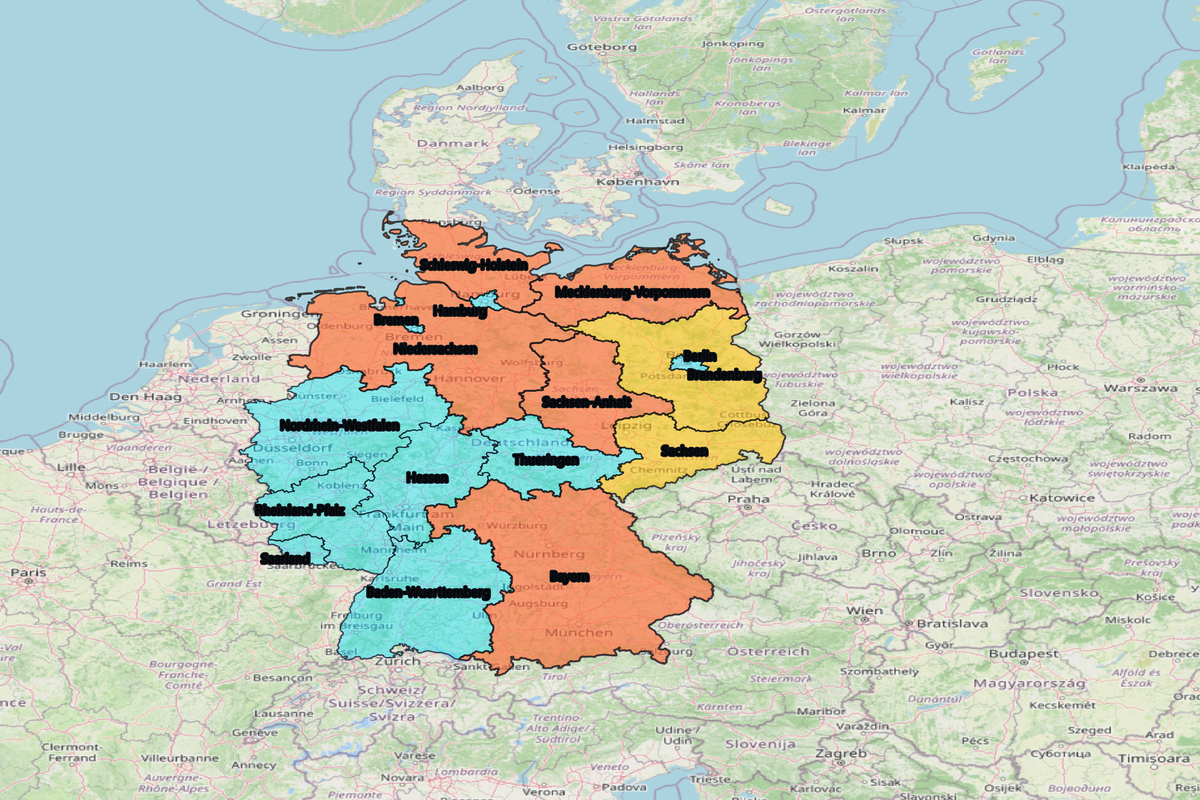
The map below shows Germany's current grid constraint geography — curtailment zones, transmission corridors under construction, and the north-south structural divide the Netzpaket is responding to:
Interactive map: Germany's grid constraint zones, HVDC corridor status, and curtailment geography. Built on ENTSO-E and BNetzA data.
https://maps.thelayeredgrid.com/Germany_Grid_Limits.html
The Investor Signal
For over two decades, financial modelling of German renewable assets treated curtailment as a rounding error. If a project was built, it produced electricity; if it was curtailed, it was paid as if it had not been. The Redispatch-Vorbehalt ends that convention entirely.
Redefining the LCOE calculation. The standard Levelised Cost of Electricity formulation treats energy yield as a deterministic variable. Under the Netzpaket, any project connecting within a capacity-limited zone must now model expected curtailment as a first-class input — a dynamic loss factor applied to net yield over the ten-year waiver period. If historical curtailment in a designated zone is already running at 5-10%, modelling a curtailment rate of zero is not conservatism; it is the path to insolvency.
The consequence flows directly into project finance. Lenders who have historically accepted debt-to-equity ratios of 80:20, backstopped by guaranteed feed-in tariffs or long-term PPAs, will respond to uncompensated volume risk in predictable ways: higher required Debt Service Coverage Ratios (DSCRs), structural curtailment sweeps in debt-sizing calculations, and an upward repricing of the cost of capital to compensate for the unhedged volume exposure. In the secondary market, the divergence will be immediate: existing operating assets with grandfathered, fully compensated grid access command a premium; new-build greenfield projects in constrained zones see their equity valuations compressed and their required PPA strike prices rise.
This repricing will not be gradual. The BNetzA is required to publish the list of designated capacity-limited zones annually by 31 March. On the day that first list appears, every project in those zones with an unexecuted PPA is a renegotiation.
Battery storage as mandatory capital expenditure. The Netzpaket acts as a regulatory accelerant for co-located Battery Energy Storage Systems (BESS). In a designated zone, a standalone wind or solar asset absorbing uncompensated curtailment is economically impaired. A co-located BESS captures that curtailed generation — which would otherwise be lost for free — and dispatches it when local line capacity clears or when price differentials justify it. The logic shifts BESS from optional revenue stack to structural prerequisite for bankability. Ember's analysis confirms that had Germany's announced large-scale BESS pipeline (10.5 GW / 26.3 GWh) been operational in 2025, it could have avoided approximately one-third of total curtailment, saving around €0.8 billion in redispatch costs and gas substitution combined.
The Netzpaket also runs in parallel with the Solarspitzengesetz of early 2025, which introduced zero tariffs during negative price windows and a default 60% active power output cap for non-controllable systems below 100 kWp. The combined regulatory signal is unambiguous: passive power injection is no longer tolerated as a business model.
Operational management at 15-minute resolution. The loss of compensated curtailment forces asset managers to rebuild their operational models from the ground up. The historical approach — monthly kWh reconciliation against a theoretical yield curve — cannot distinguish between technical underperformance and uncompensated grid-driven curtailment. Under the Redispatch-Vorbehalt, that distinction is the difference between a warranty claim and an unrecoverable loss. Real-time performance monitoring, reconciled against physical grid data at 15-minute intervals, transitions from operational best practice to contractual necessity.
The European Read-Across
Germany is not an isolated case. It is the first major EU member state to codify the response. The physical laws governing AC power systems do not respect national borders, and the pressures driving the Netzpaket are already visible across the continent.
The Netherlands has faced grid congestion severe enough to close large portions of its medium- and high-voltage network to new connections entirely. Rather than waiting for reinforcement timelines measured in decades, the Dutch Authority for Consumers and Markets (ACM) introduced Non-Firm Access (NFA) agreements from February 2024 — the conceptual predecessor to the Redispatch-Vorbehalt, but with a compensating mechanism: up to 100% reduction in fixed grid connection fees for assets that accept full curtailment rights. The Dutch reform structured three NFA pathways (standard NFA, Time Dependent Transport Rights, and Time Block Transport Rights), each calibrated to different risk tolerances. The elegant side-effect is a strong price signal toward BESS: variable grid fees are heavily discounted during solar midday peaks and penalise charging during winter demand stress.
Spain provides the most visceral illustration of what system fragility looks like at scale. The April 2025 blackout — which swept the Iberian peninsula and exposed critical vulnerabilities in voltage control under high renewable penetration — triggered an immediate tightening of REE's security operating margins. The consequence was a curtailment spike from a pre-blackout range of 1-3% of renewable output to an unprecedented 11% in July 2025, with some provinces in Toledo, Ciudad Real, and Granada recording local curtailment rates exceeding 30%. Total system security and restriction costs climbed 49% year-on-year to €3.77 billion. Crucially, the majority of Spanish curtailment occurs in Phase I (pre-dispatch scheduling), which carries zero financial compensation — the structural equivalent of the Redispatch-Vorbehalt, enacted by operational protocol rather than statute.
Denmark has taken a different route for its 9 GW offshore expansion: strict mutual liability in concession agreements, with Energinet bound by objective liability if it fails to deliver a connection point by the agreed date (capped at DKK 1.54 billion per project), and developers bound by equivalent strict liability for construction delay. Overplanting capacity above the pre-agreed minimum is explicitly excluded from any delay compensation — a hard limit on speculative capacity additions that the German queue currently allows.
Italy is watching. The structural geography mirrors Germany almost exactly: world-class solar resources in Puglia, Calabria, and Sicily; exceptional wind in the southern Apennines; industrial load concentrated in Lombardy, Veneto, and Piedmont. Terna executes extensive redispatch to manage the north-south voltage cleavage. The Tyrrhenian Link is underway, but the regulatory tools Italy will eventually reach for — regional non-compensated curtailment zones, quality-based queue prioritisation — are being road-tested in Berlin.
A condensed picture of where each major market currently stands:
| Country | Core Mechanism | Compensation Policy | Strategic Impact |
|---|---|---|---|
| Germany | Capacity-limited grid areas (§14 EnWG, draft) | Complete waiver (Redispatch-Vorbehalt) for up to 10 years | Spikes LCOE; mandates co-located storage; forces real-time curtailment tracking |
| Netherlands | Non-Firm Access (NFA, TDTR, TBTR) | No curtailment compensation; offset by up to 100% reduction in fixed connection fees | High incentive for BESS; variable fee weightings reward peak-shaving dispatch |
| Spain | Technical Restrictions (restricciones técnicas) | Zero compensation for Phase I pre-dispatch curtailments | Severe valuation pressure on greenfield solar; high regional revenue volatility |
| Denmark | Strict liability offshore concessions | Compensation for forced curtailment; overplanting excluded | Limits unhedged capacity additions; high legal-contractual discipline on developers |
The End of the Infinite Grid
Germany's Netzpaket will attract sustained criticism — and some of it is earned. The fragmentation risk is real: 866 VNBs each designing their own connection queue processes is not a national energy policy, it is a regulatory archipelago. The industry concern that the waiver mechanism will systematically divert capital away from grid-constrained zones — precisely the zones that most need investment to resolve the congestion — is a legitimate second-order effect that the draft does not adequately address. And there is a causality problem that the legislation sidesteps entirely: the grid is not congested because developers built in the wrong places. It is congested because SuedLink is nine years late.
None of that changes what the Netzpaket represents as a signal.
For over two decades, European decarbonisation policy operated on an implicit physical promise: build generation wherever the resource is strongest, and mandate the ratepayer to fund both the grid expansion required to absorb it and the compensation costs incurred when that expansion fails to keep pace. The leaked draft from the BMWE is a formal admission that this model has reached its fiscal and physical limit. Germany spent €2.8 billion on redispatch in 2024 — a fifteen-fold increase over a decade. The ratepayer has absorbed that cost through network charges with almost no public visibility. The Netzpaket is the moment policymakers decide to make it visible, and to make it someone else's problem.
The 3% threshold is not an engineering standard. It is a political line: below it, the system absorbs the cost collectively; above it, the generator absorbs it alone. Every renewable developer, project finance lender, and infrastructure fund operating in Germany — and shortly, in every EU market facing the same physics — needs to understand that line, map it against their portfolio geography, and model it as a permanent feature of the risk landscape rather than a transitional aberration.
The era of the passive, grid-compensated generator is over. Germany went first. The rest of Europe is watching, and the capital markets are quietly doing the arithmetic.
Nicolai Gissur is the founder of the Industrial Infrastructure Intelligence Platform (IIIP) and writes The Layered Grid — a long-form publication on European energy infrastructure.
The interactive map embedded in this article was built using ENTSO-E transmission data, BNetzA planning corridor records, and OSM-sourced grid infrastructure. It is part of the IIIP spatial intelligence stack.
Sources
- BMWE, Referentenentwurf: Gesetz zur Änderung energiewirtschaftsrechtlicher Vorschriften zur Synchronisierung des Anlagenzubaus mit dem Netzausbau, 13 January 2026 [Primary — draft legislation]
- Baker McKenzie, Germany: Grid Package (Draft), 17 March 2026 [Industry body — legal analysis]
- Taylor Wessing, The German Government's Grid Package: New Rules for Grid Connection, May 2026 [Industry body — legal analysis]
- GÖRG, BMWE-Netzpaket: Overview of Plans to Change Grid Connection Procedures, 20 February 2026 [Industry body]
- Clean Energy Wire, Q&A: Will Germany's Upcoming Electricity Grid Reform Slow Down the Energy Transition?, 10 March 2026 [Journalism — primary]
- Clean Energy Wire, Renewable Curtailment Compensation Costs in Germany Decrease 22% in 2025, 24 March 2026 [Journalism — data]
- Modo Energy, Germany Redispatch Explainer, July 2025 [Industry body — 2024 curtailment data, €2.8B system cost]
- Ember, Germany's Battery Opportunity, May 2026 [Industry body — BESS curtailment reduction modelling]
- Strategic Energy Europe, Solar Curtailment Surges 97% in Germany in 2024, April 2025 [Journalism — Bavaria solar data]
- White & Case, Battery Energy Storage Systems — The Changing Regulatory Framework in Germany, 10 March 2026 [Industry body — BESS queue data]
- Bundesnetzagentur, Monitoring Report 2024/2025 [Primary — curtailment statistics]
- ENTSO-E, Ten-Year Network Development Plan (TYNDP) 2024 [Primary — transmission corridor data]
Comments ()