A Brief History of Harnessing Earth's Heat
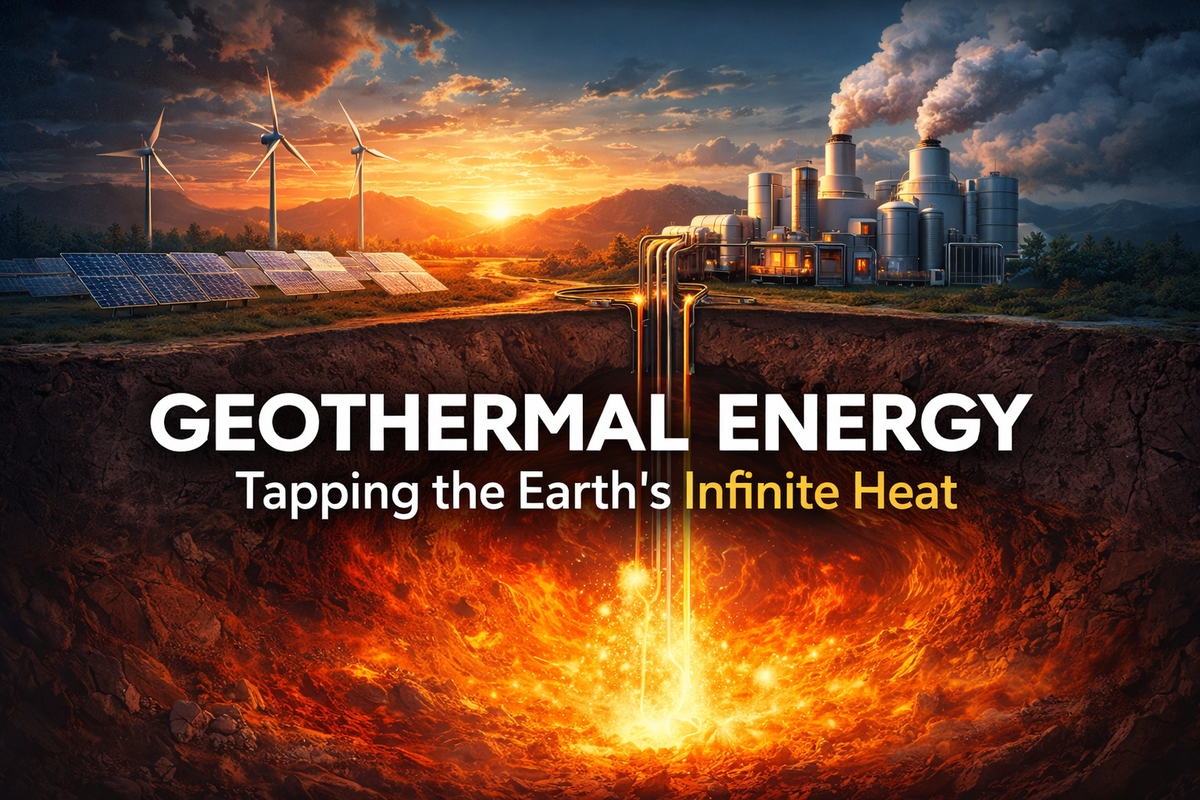
You know, when we think about the most powerful, most reliable source of energy on our planet, what comes to mind? The sun is great, but it sets every night. The wind is powerful, but it dies down. But what if I told you the biggest source of all is the immense, primal heat that's churning right beneath our feet, 24/7? Let's dive into this incredible and honestly, often overlooked resource.
And this, this is what that raw power looks like. For billions of years, the Earth's core has been doing its thing, sending a constant flow of heat up towards us. It's a process that never, ever stops. It's like a planetary-scale engine that's been running nonstop.
And the name we have for this energy? It's beautifully simple: Geothermal. You got "Geo" for Earth, and "thermal" for heat. So in this explainer, we're going to trace the incredible story of how we went from just, you know, enjoying this warmth to actually harnessing it to power our entire modern world.
To really get where we're going with all this, we first need to look back. So let's start at the very beginning, with how humanity first started using the planet's inner warmth.
Now, this timeline tells a really fascinating story. For literally tens of thousands of years, our relationship with geothermal energy was pretty passive. We basically just used the heat that bubbled up to the surface. And then, in what is just a blink of an eye in geologic time, we made this monumental leap.
I mean, for centuries, cultures all across the globe just, they got it. From the famous Roman baths with their heated floors, to Native American communities using geysers for cooking, this was direct-use energy at its absolute finest. You found the heat, and you used it right there. Simple as that.
And then, came this year: 1904. After millennia of just bathing in hot springs, this single year marks the moment, the pivotal moment, when our whole relationship with geothermal energy changed forever.
So here's the massive shift. For the very first time, we weren't just using the heat. We were converting it into something else: electricity. That first plant in Larderello, Italy, proved it could be done. And you know what's truly incredible? That same geothermal field is still in production today, helping power about a million households. Talk about sustainability.
Alright, let's fast forward to today. The really cool thing is, we're no longer just limited to places with obvious hot springs gushing out of the ground. Technology has basically unlocked the heat that's present everywhere, just under the surface.
This diagram shows the whole spectrum of modern geothermal tech perfectly. The easiest way to think about it is this: the deeper you go, the more power you unlock. On one end, you've got these shallow systems that can heat and cool a single home. But on the other end, we're drilling miles down, creating our own reservoirs in super-hot rock to power entire cities. We can now tap into Earth's heat at any scale we need.
So you might be asking, how did we get so good at this? Well, a lot of the key innovations, like these super strong drill bits and precision drilling, were actually pioneered by the oil and gas industry. We've basically adapted that tech to unlock clean, limitless heat instead, which is making geothermal a real possibility in so many more places around the world.
But the story doesn't just stop with generating power. Nope. The most exciting chapter is being written right now, where we're using the Earth itself to solve one of the biggest challenges in all of clean energy.
This is it. This is the fundamental question of the whole energy transition. Solar and wind are amazing, but they're intermittent, right? They produce power when the conditions are right, not necessarily when we actually need it. So, what do you do with all that extra energy? How do you store it?
And here is the elegant answer. We can use the Earth itself as a massive virtual battery. This isn't about manufacturing millions of chemical batteries. It's about storing huge amounts of surplus energy as pure heat, holding it right there in the ground.
And the process is so straightforward. Step one, you charge it. When you have too much solar or wind power on the grid, you use that cheap electricity to heat up water. Step two, you store it. You hold that super-hot water in these giant insulated tanks. And step three, you discharge it. Later, when demand is high, you just tap that stored heat to generate electricity or even heat entire neighborhoods.
And this battery can work on two totally different timescales. You can have day-to-day storage in those big tanks to help balance the grid every 24 hours. Or, and this is amazing, you can go even bigger with seasonal storage, using enormous underground pits to literally capture the intense heat of summer and save it for the dark, cold days of winter.
And this is the ultimate takeaway. This is the whole point. Thermal storage solves the intermittency problem. It's the missing piece of the puzzle for solar and wind, turning their fluctuating output into a firm, reliable, around-the-clock source of clean power.
So, we've come a very long way from ancient hot springs to these planetary-scale batteries. Let's kind of wrap this up and look at the incredible potential that's still ahead.
Okay, just take a second to really let this sink in. The amount of heat energy stored in the Earth's crust, it's not just large, it's staggering. It completely dwarfs the energy in all the coal, oil, gas, and nuclear fuel on the planet combined. The resource we're just now learning to tap into isn't just sustainable; for all practical purposes, it's infinite.
So, what are the key things to remember from all this? First, geothermal has grown up, from simple hot springs to some really advanced grid technology. Second, it provides constant, 24/7 power. Third, new tech is making it possible to access this almost anywhere. And finally, and maybe most importantly, its ability to store energy makes it the perfect partner to unlock the full potential of solar and wind.
And that really leaves us with one final thought. As we're building this clean energy future and looking for all these complex solutions, is it possible that the most powerful, abundant, and reliable one has been right here, right under our feet, all along?
Comments ()